
KitSwitch
Controlled switch for a boolean preference.
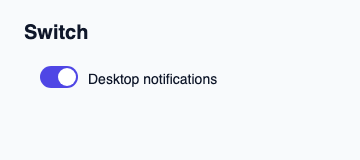
Project checked and handle toggled(bool) to accept the new state. Use a label describing the enabled preference.
Activation proposes the inverse of the current value without changing it locally. FieldAccess.read-only keeps the control available for inspection and .disabled blocks interaction.
Complete example
This complete Slint file is a visual composition used to produce the screenshot above. Internal strings without a label property retain the kit’s default language; system dialogs follow the host platform. Projected state and callbacks requesting a decision need host wiring; the standalone fixture does not supply that controller. Set up the Rust project, then see the typed controller application for working editing, validation and selection.
// SPDX-License-Identifier: GPL-3.0-or-later
import { KitSwitch, KitTheme, KitThemes } from "@kit/kit.slint";

export component Example inherits Window {
    title: "KitSwitch example";
    preferred-width: 360px;
    preferred-height: 160px;
    max-width: 100000px;
    max-height: 100000px;
    background: root.theme.canvas;
    in-out property <KitTheme> theme: KitThemes.light;
    in-out property <string> status;
    VerticalLayout {
        padding: 24px; spacing: 16px; alignment: start;
        Text { text: "Switch"; color: root.theme.text-primary; font-size: 20px * root.theme.text-scale; font-weight: 600; }
        KitSwitch { theme: root.theme; label: "Desktop notifications"; checked: true; toggled(value) => { root.status = value ? "Enable requested" : "Disable requested"; } }
        if root.status != "": Text { text: root.status; color: root.theme.text-secondary; font-size: 12px * root.theme.text-scale; wrap: word-wrap; }
    }
}
Public API
Inherits KitPressable. The declarations below come from the component source. Parent properties remain available; see the controller guide for state management.
Properties
| Name | Type | Direction |
|---|---|---|
checked |
bool |
in |
access |
FieldAccess |
in |
label |
string |
in |
Types and variants
Names below use Slint syntax. Shared Rust domain types live in slint_kit; presentation enums come from the Rust types generated by Slint.
| Type | Declaration |
|---|---|
enum FieldAccess |
editable, read-only, disabled |
Callbacks
toggled(bool)